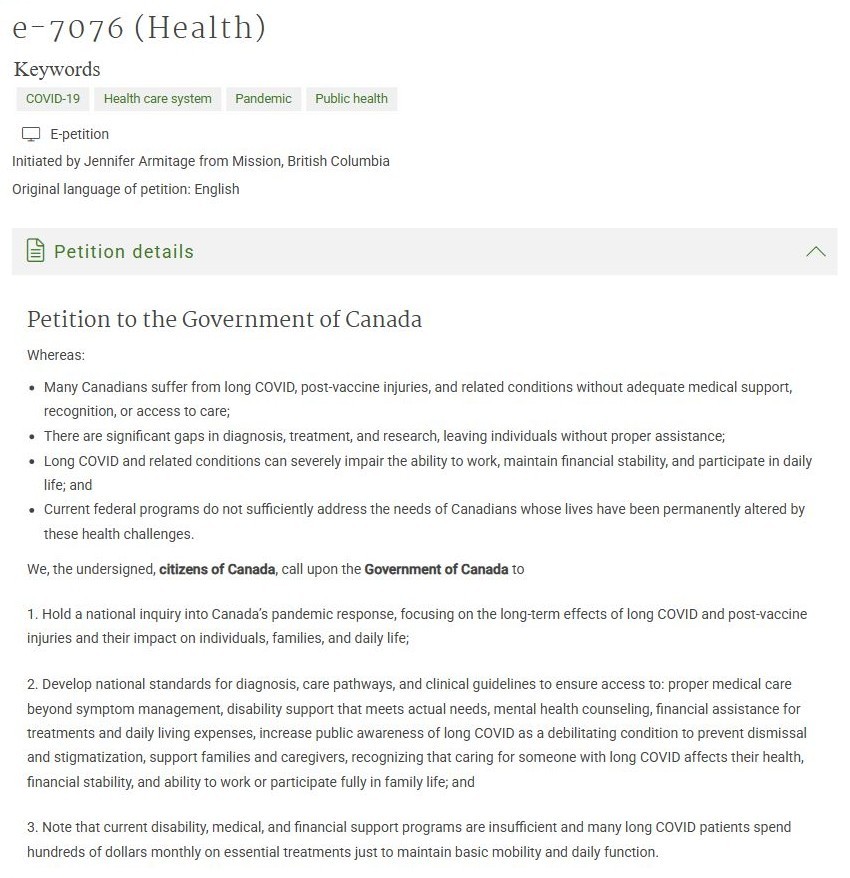
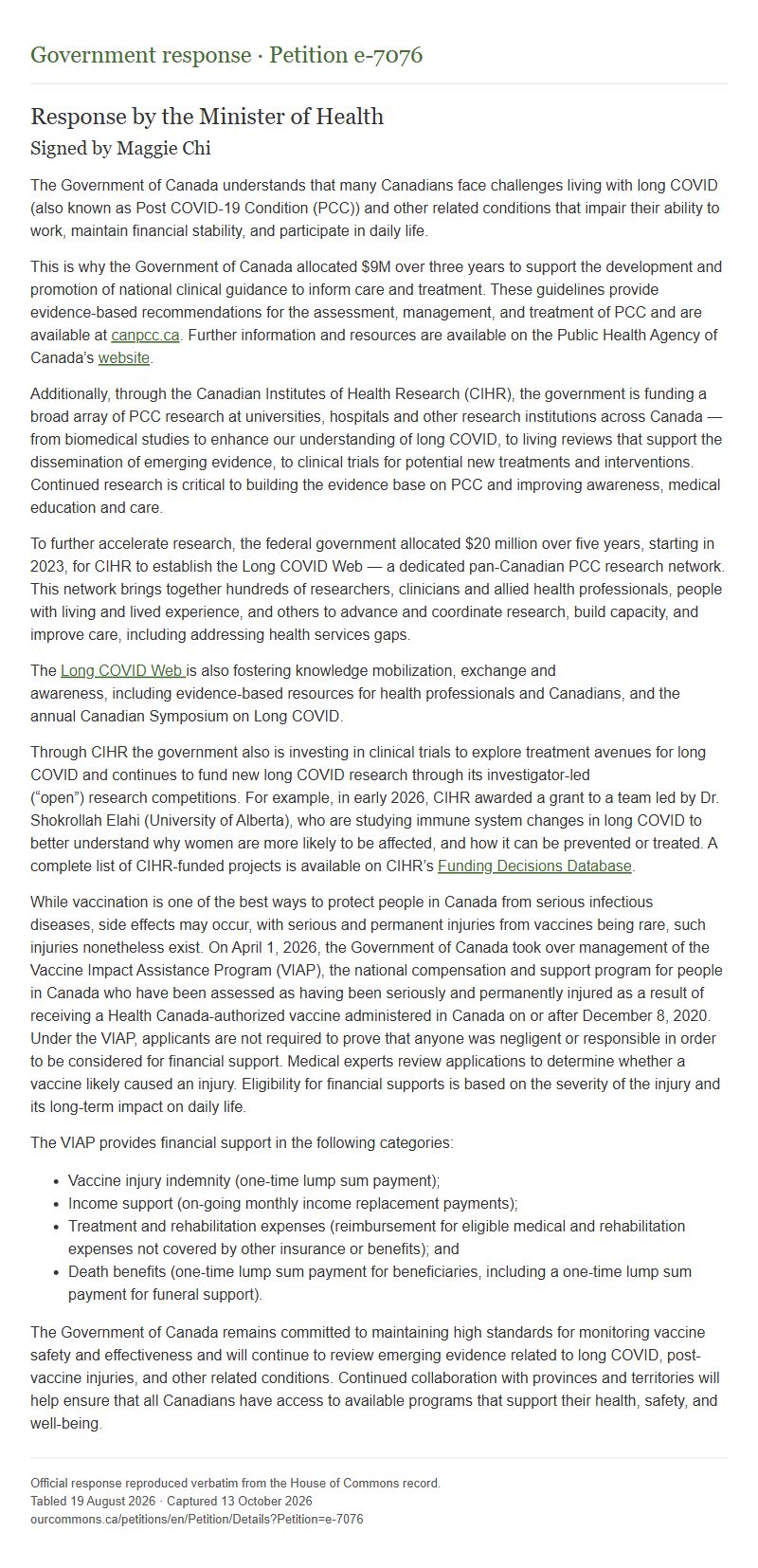
More than 1,100 Canadians signed petition e-7076, calling for national Long COVID care standards, disability support and financial relief. The government’s 19 August 2026 response pointed to existing research and guideline funding, but made no new commitments on care access, standards or income support.
On 20 October, LCAC mailed letters to 15 federal leaders asking what will actually change for patients. You can ask your Member of Parliament (MP) to press for answers too.
LCAC mailed 15 follow-up letters to federal leaders on 20 October 2026. Parliamentary Secretary Maggie Chi’s office confirmed receipt on 16 November; substantive replies are still awaited.
Next step
Track replies from federal ministers, MPs, and the Health Committee, and publish substantive responses.
Gathering input, done
Request sent, current step
Response received
Following up
Resolved
Step 2 of 5
Updated 18 November 2026
Federal budget · 5 November 2026
What the budget means for Long COVID
Budget 2026 proposes broader health and tax changes. It announces no new dedicated funding for Long COVID research or care and no increase to the Canada Disability Benefit.
On 20 October 2026, LCAC mailed 15 follow-up letters about the petition’s unanswered requests. They went to the Prime Minister, the Minister of Health, other ministers, opposition health and disability critics, the petition’s sponsor and the House of Commons Health Committee. One office has confirmed receipt so far. Substantive replies are still awaited.
Replies so far
— Office of Maggie Chi, MP, Parliamentary Secretary to the Minister of Health (signer of the 19 August response): confirmed that LCAC’s letter was received and shared with Ms. Chi, and said she will reach out if she has questions. This is an acknowledgment, not an answer to the four questions. On , LCAC wrote back asking for a written response to the questions, an expected timeline, and whether the inquiry is being routed to Health Canada.
No reply yet from the other 14 recipients. Got a reply from your MP? Share it privately.
The core question: What have federal Long COVID investments changed for patients, and how will the government measure progress?
What our 20 October letters ask
Results for patients: Report measurable improvements in access to timely diagnosis, knowledgeable specialist care, treatment, disability support, and income security—with baselines, reporting periods, and results.
Guidance into care: Explain how Ottawa is working with provinces and territories to put national clinical guidance into practice, including federal responsibilities, milestones, wait-time tracking, and regional access gaps.
Disability and treatment costs: Identify the steps and responsible federal departments assessing unmet disability-income and out-of-pocket treatment costs for people with Long COVID, along with upcoming decisions or reviews.
Unanswered petition requests: State the government’s position, next steps, and timetable on the petition’s calls for a national inquiry and national minimum standards for diagnosis and care pathways.
The letters also ask for a named federal contact, a date for public progress reporting, and accessible participation for people living with Long COVID in setting priorities and reviewing progress.
Letters sent (15 recipients · Mailed 20 October 2026)
Mailed 20 October 2026
Redacted copies of the final letters, dated 17 October 2026. Home address, direct email and personal health and financial details have been removed. Enclosures are omitted.
Read the core letter text & 10 October consultation draft
Retained for reference. This public consultation draft was open for community feedback before the 20 October 2026 mailing. It is not a copy of the personalized final letters dated 17 October.
Long COVID Action Canada (LCAC) is following up on the government response to House of Commons petition e-7076, tabled on 19 August 2026. We welcome investment in research and clinical guidance. We ask for a public account of what these investments have changed for people living with Long COVID.
The response describes national clinical guidance, CIHR-funded research and Long COVID Web. Research funding and guidance do not, by themselves, show whether patients can access care. The response provides no patient-outcome measures or timelines for closing these gaps, and identifies no new Long COVID-specific disability-income or treatment-cost support.
Please provide a written response to the following questions:
1. Results for patients. What measurable improvements have federal Long COVID investments produced in access to timely diagnosis, knowledgeable specialist care, treatment, disability support and income security? Please identify the measures, baseline, reporting period and results. Where results are not yet available, please state when they will be reported.
2. Guidance into care. How is the government working with provinces and territories to put national clinical guidance into practice? Please identify federal responsibilities, planned milestones and how access and wait times will be assessed, including regional gaps.
3. Disability and treatment costs. What steps will the federal government take, within its responsibilities, to assess and address unmet disability-income and treatment-cost needs among people with Long COVID? Please identify the responsible departments and the next decisions or reviews.
4. Open requests. Does the government intend to pursue a national inquiry or national minimum standards for diagnosis and care pathways, as raised in the petition? Please explain its position, the next steps and any timetable.
We ask that the response identify a responsible federal contact and a date for the next public progress report. Please include how people living with Long COVID will participate accessibly in setting priorities and reviewing progress.
LCAC intends to publish this letter and the substantive response so patients can follow the commitments and next steps. Please acknowledge receipt and indicate when a full response can be expected.
Sincerely, Robert DeRosa Long COVID Action Canada hello@longcovidaction.ca
What the petition asked, and what the response says.
LCAC’s assessment of the government’s 19 August 2026 response. Petition e-7076 asked the federal government for a national inquiry and better care, disability support and financial help. It also addressed post-vaccine injuries. The petition closed with 1,103 validated signatures and was presented in Parliament on 17 June 2026.
The Minister of Health’s response points to:
$9 million over three years — for national clinical guidance on assessing, managing, and treating Long COVID (CanPCC).
$20 million over five years (since 2023) — for Long COVID Web, a pan-Canadian research network funded through CIHR.
Research and clinical trials — funded through CIHR to study disease mechanisms and potential treatments.
These investments support research and clinical knowledge. The question is how they lead to care and support people can obtain. Seven themes are compared below; they are LCAC’s groupings, not the petition’s numbered requests.
Petitioners asked forA national inquiry into the long-term effects of Long COVID and post-vaccine injuries
The 19 August responseNo commitment to a national inquiry.
Budget 2026No inquiry announced.
Petitioners asked forNational standards for diagnosis and care pathways
The 19 August responseCites clinical guidance, but gives no commitment to national minimum care standards or a timetable for putting them into practice.
Budget 2026No dedicated funding or timetable to put the national Long COVID guidance into practice.
Petitioners asked forAccess to medical care beyond symptom management
The 19 August responseNo new care-access program, specialist-access commitment or patient wait-time targets.
Budget 2026No dedicated Long COVID research or clinic funding announced. Broader home and community care funding is proposed through March 2028.
Petitioners asked forDisability support that reflects patients’ actual needs
The 19 August responseNo new federal disability or income-support measures specific to Long COVID.
Budget 2026No proposed increase to the Canada Disability Benefit or change to its Disability Tax Credit requirement.
Petitioners asked forFinancial help with treatment costs and daily living expenses
The 19 August responseNo new Long COVID-specific treatment-cost or daily-living assistance identified.
Budget 2026Proposes simpler paperwork for some medical expense claims. No dedicated Long COVID treatment-cost support.
Petitioners asked forPublic awareness to reduce dismissal and stigma
The 19 August responseCites research, education and Long COVID Web’s awareness resources. No dedicated public-awareness campaign or measurable stigma-reduction commitments.
Budget 2026No dedicated Long COVID public awareness measure announced.
Petitioners asked forMental health counselling and support for families and caregivers
The 19 August responseNo new Long COVID-specific counselling or caregiver-support measures identified.
Budget 2026Proposes a refundable caregiver credit starting in 2027 and a one-year extension of broader mental health and addictions agreements.
LCAC is asking federal leaders to identify responsibilities, milestones and patient outcomes, including work with provinces and territories. Funding totals alone do not show whether diagnosis, care or financial security have improved.
This assesses commitments in this response. It does not mean existing benefits are unavailable to people with Long COVID, or that the government has formally rejected every unanswered request.
Read the full analysis
The petition’s scope
The requests go beyond research funding.
Jennifer Armitage of Mission, British Columbia, initiated e-7076. Brad Vis, MP for Mission—Matsqui—Abbotsford, presented it in the House of Commons. LCAC groups its requests into seven themes:
a national inquiry into Canada’s pandemic response and the long-term effects of Long COVID and post-vaccine injuries;
national standards for diagnosis, care pathways and clinical guidance;
medical care beyond symptom management;
disability support that meets patients’ actual needs;
financial assistance for treatment and daily living expenses;
public awareness to reduce dismissal and stigma; and
mental health counselling and support for families and caregivers, recognizing the effects on their health, income and daily life.
The petition says existing disability, medical and financial programs are insufficient. Read the original wording, which contains three numbered requests.
The federal investments cited
What the response says those investments support.
The response, signed by Maggie Chi, Parliamentary Secretary to the Minister of Health, acknowledges the challenges of Long COVID, called Post COVID-19 Condition in federal materials.
Clinical guidance: $9 million over three years for development and promotion of evidence-based recommendations, published at canpcc.ca.
Long COVID Web: $20 million over five years from 2023 for a pan-Canadian research network bringing together researchers, clinicians and people with lived experience. Its work includes research coordination, knowledge sharing and health-service gaps.
Biomedical studies and trials: CIHR funding for disease mechanisms, living evidence reviews and possible treatments. The response gives an early-2026 grant to Dr. Shokrollah Elahi’s University of Alberta team as an example, studying immune-system changes and why women are disproportionately affected.
Most of these are existing initiatives cited in the response, rather than new measures announced to meet the petition’s requests. The response does not provide patient-outcome results or an implementation timetable.
Guidance into care
Recommendations need an implementation plan.
Clinical guidance can help clinicians make informed decisions. It does not itself fund a clinic, create a specialist appointment or establish minimum access to care. The response gives no new national care-access program or specific commitments on waiting times, treatment costs or Long COVID disability income.
LCAC’s follow-up asks the federal government to explain its responsibilities and its work with provinces and territories: who will act, which resources are available, when milestones will be reached, and how patients will be involved. It also asks for a clear position on the national inquiry and national minimum standards.
Support for vaccine injuries
A separate program is described in the same response.
Because the petition also addresses post-vaccine injuries, the response describes the Vaccine Impact Assistance Program (VIAP), managed directly by Ottawa from 1 April 2026. Medical experts assess whether a Health Canada-authorized vaccine likely caused a serious and permanent injury, subject to the program’s eligibility rules.
The response lists four types of support for eligible recipients:
Vaccine injury indemnity: a one-time payment.
Income support: ongoing monthly income replacement.
Treatment and rehabilitation expenses: eligible costs not covered by other insurance or benefits.
Death benefits: including funeral support.
The Long COVID portion identifies no comparable condition-specific mechanism for treatment reimbursement or income replacement. LCAC supports assistance for both populations and asks the government to address the Long COVID needs the petition raised.
How progress should be measured
Report what patients can actually access.
Research remains essential for identifying disease mechanisms, biomarkers and effective treatments. To assess the wider response, LCAC asks for measures with a baseline, reporting period and results:
time to diagnosis and knowledgeable specialist care;
access to evidence-supported treatments and care informed by national guidance;
adequacy of disability income and unmet treatment expenses; and
differences in access across provinces and territories.
The response does not report these outcomes. A public progress report would help patients judge whether federal investments are improving care and economic support, alongside the research they fund.
How you can help
EmailAbout 10 minutes
Ask your MP to follow up
Find your MP, add your experience, and review a letter asking for answers to the petition’s unresolved requests.
Subject: Constituent request: Follow-up on House of Commons petition e-7076 (Long COVID) — [Your postal code]

Dear [MP’s name],

I am a constituent in [your riding]. Please follow up on the government’s response to petition e-7076, tabled on 19 August 2026.

Research and clinical guidance are welcome, but the response leaves questions about access to care, disability support and treatment costs unanswered.

[Optional: add a sentence about why this matters to you.]

Please seek a written response from the Minister of Health and other responsible ministers:

1. What is the government’s position on the petition’s requests for a national inquiry, national care standards and additional disability and financial support?

2. How will federal investments and guidance lead to accessible diagnosis, care and treatment? Please identify responsibilities, funding and timelines, including work with provinces and territories.

3. How will progress be measured and reported, and how will people living with Long COVID help set priorities?

Please share the response with me.

Petition and official response: https://www.ourcommons.ca/petitions/en/Petition/Details?Petition=e-7076
LCAC’s analysis: https://longcovidaction.ca/federal-response

Thank you,
[Your name]
[Your postal code]
The Government of Canada understands that many Canadians face challenges living with long COVID (also known as Post COVID-19 Condition (PCC)) and other related conditions that impair their ability to work, maintain financial stability, and participate in daily life.
This is why the Government of Canada allocated $9M over three years to support the development and promotion of national clinical guidance to inform care and treatment. These guidelines provide evidence-based recommendations for the assessment, management, and treatment of PCC and are available at canpcc.ca. Further information and resources are available on the Public Health Agency of Canada’s website.
Additionally, through the Canadian Institutes of Health Research (CIHR), the government is funding a broad array of PCC research at universities, hospitals and other research institutions across Canada — from biomedical studies to enhance our understanding of long COVID, to living reviews that support the dissemination of emerging evidence, to clinical trials for potential new treatments and interventions. Continued research is critical to building the evidence base on PCC and improving awareness, medical education and care.
To further accelerate research, the federal government allocated $20 million over five years, starting in 2023, for CIHR to establish the Long COVID Web — a dedicated pan-Canadian PCC research network. This network brings together hundreds of researchers, clinicians and allied health professionals, people with living and lived experience, and others to advance and coordinate research, build capacity, and improve care, including addressing health services gaps.
The Long COVID Web is also fostering knowledge mobilization, exchange and awareness, including evidence-based resources for health professionals and Canadians, and the annual Canadian Symposium on Long COVID.
Through CIHR the government also is investing in clinical trials to explore treatment avenues for long COVID and continues to fund new long COVID research through its investigator-led (“open”) research competitions. For example, in early 2026, CIHR awarded a grant to a team led by Dr. Shokrollah Elahi (University of Alberta), who are studying immune system changes in long COVID to better understand why women are more likely to be affected, and how it can be prevented or treated. A complete list of CIHR-funded projects is available on CIHR’s Funding Decisions Database.
While vaccination is one of the best ways to protect people in Canada from serious infectious diseases, side effects may occur, with serious and permanent injuries from vaccines being rare, such injuries nonetheless exist. On April 1, 2026, the Government of Canada took over management of the Vaccine Impact Assistance Program (VIAP), the national compensation and support program for people in Canada who have been assessed as having been seriously and permanently injured as a result of receiving a Health Canada-authorized vaccine administered in Canada on or after December 8, 2020. Under the VIAP, applicants are not required to prove that anyone was negligent or responsible in order to be considered for financial support. Medical experts review applications to determine whether a vaccine likely caused an injury. Eligibility for financial supports is based on the severity of the injury and its long-term impact on daily life.
The VIAP provides financial support in the following categories:
Vaccine injury indemnity (one-time lump sum payment);
Income support (on-going monthly income replacement payments);
Treatment and rehabilitation expenses (reimbursement for eligible medical and rehabilitation expenses not covered by other insurance or benefits); and
Death benefits (one-time lump sum payment for beneficiaries, including a one-time lump sum payment for funeral support).
The Government of Canada remains committed to maintaining high standards for monitoring vaccine safety and effectiveness and will continue to review emerging evidence related to long COVID, post-vaccine injuries, and other related conditions. Continued collaboration with provinces and territories will help ensure that all Canadians have access to available programs that support their health, safety, and well-being.
Source: House of Commons, Petition e-7076 — opened 29 January 2026, closed 29 May 2026 at 1,103 validated signatures, presented 17 June 2026 (Petition No. 451-01124), government response tabled 19 August 2026. Response by the Minister of Health, signed by Maggie Chi, Parliamentary Secretary to the Minister of Health. Quoted figures and program details are taken from that response.