Share the FALCON petition
Share the petition with someone who may want to support independent review. Choose the way that works for you.
Open an email to share FALCON Why this mattersFALCON is a planned McMaster study comparing the Lightning Process with activity pacing for Long COVID.
About 2 minutes to sign. No LCAC sign-up needed.
Active campaignCampaign updated: 16 Oct 2026
On 16 October, HiREB said FALCON had undergone initial board review and was back with the study team to address the board’s questions and concerns. HiREB said the community’s concerns were considered, but gave no timeline for answers to LCAC’s questions. Read the reply.
The reply does not confirm final ethics approval or the independent scientific, ethical and patient-led review LCAC requested. The full protocol, statistical analysis plan and detailed participant-protection answers remain outstanding in the campaign record.
The 11 October follow-ups requested a response or expected response date by 22 October. That is LCAC’s requested date, not a commitment from the recipients.
Registry checked 8 October: “Not yet recruiting”; estimated start November 2026. The record was last updated 13 July. This does not confirm current enrolment. View the trial record ↗
Full campaign timeline · Next steps
LCAC will record further replies and check whether the requested documents and protections are confirmed. The other 11 October follow-ups requested a response or expected response date by 22 October.
No follow-up date has been announced. Read the planned HAHSO next step.
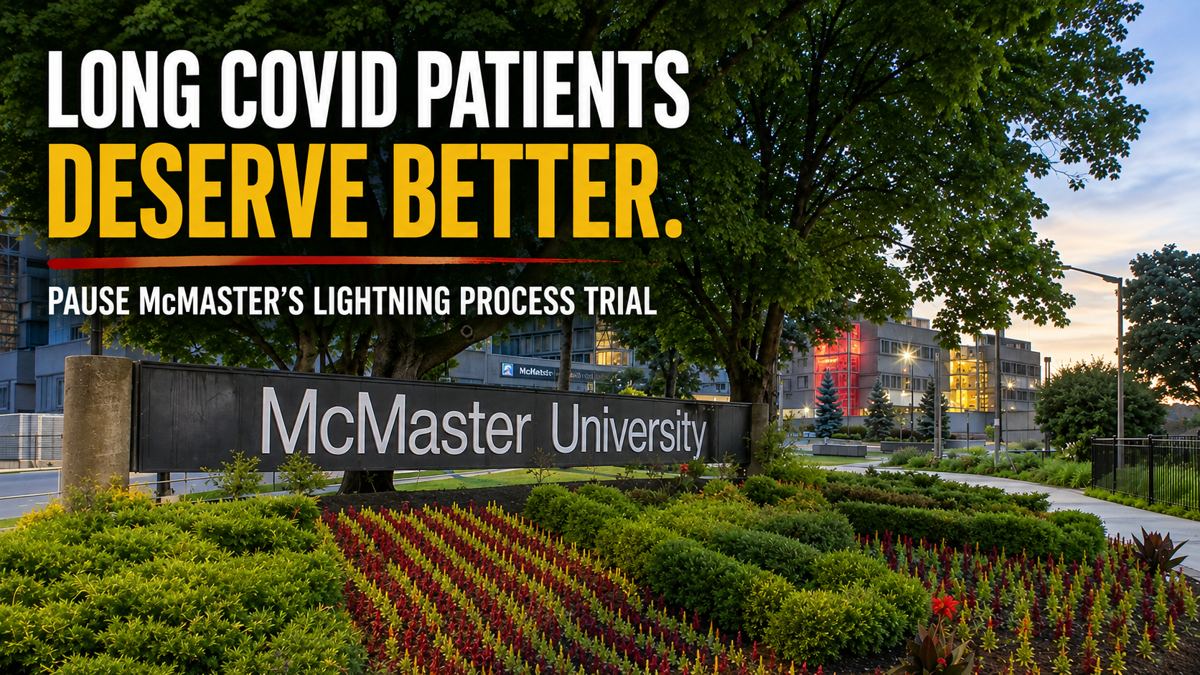
FALCON is a planned McMaster University study comparing two approaches to managing Long COVID symptoms. The public trial record describes 100 adults assigned by chance to either the Lightning Process or activity pacing, with sessions and health questionnaires completed online.
The Lightning Process is a commercially branded programme intended to change thought patterns and responses to symptoms. Activity pacing balances activity and rest to avoid worsening symptoms.
Physical or mental effort can worsen Long COVID symptoms. LCAC seeks independent review and clear safeguards so the trial can give reliable answers about benefit and harm.
Read the concerns and evidence.
Read the registered study description and interventions.
FALCON is a planned McMaster University trial for people with Long COVID. It compares the Lightning Process, a mind-body programme intended to change thought patterns and responses to symptoms, with activity pacing, which balances activity and rest to avoid worsening symptoms.
LCAC is asking for an independent review before recruitment opens, with clear participant protections and public trial documents. Read the registered trial description.
These are the changes LCAC is seeking. Open each item for the response received and what remains unresolved. The petition’s six requests are grouped into five themes here.
Still open: Confirmation of an independent scientific, ethical and patient-led review addressing the petition’s concerns. HiREB confirms initial ethics review. This does not confirm the independent review LCAC requested.
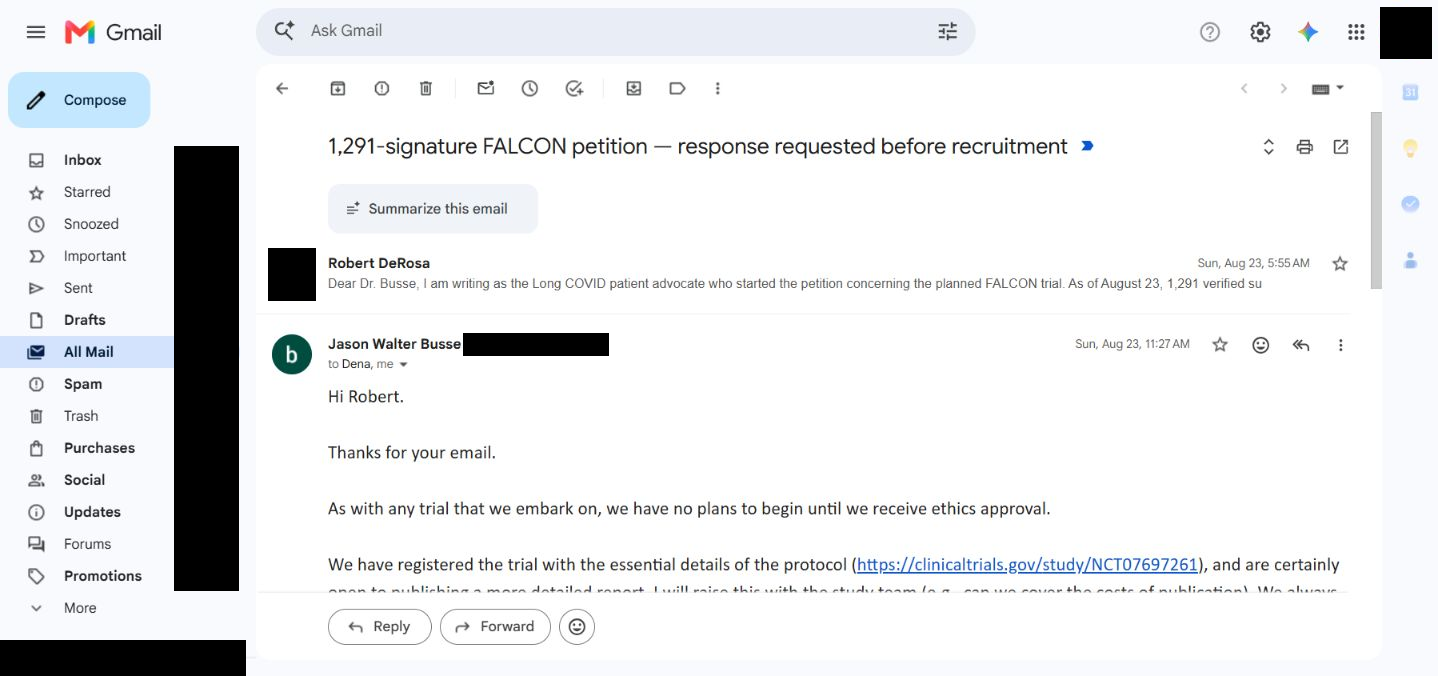
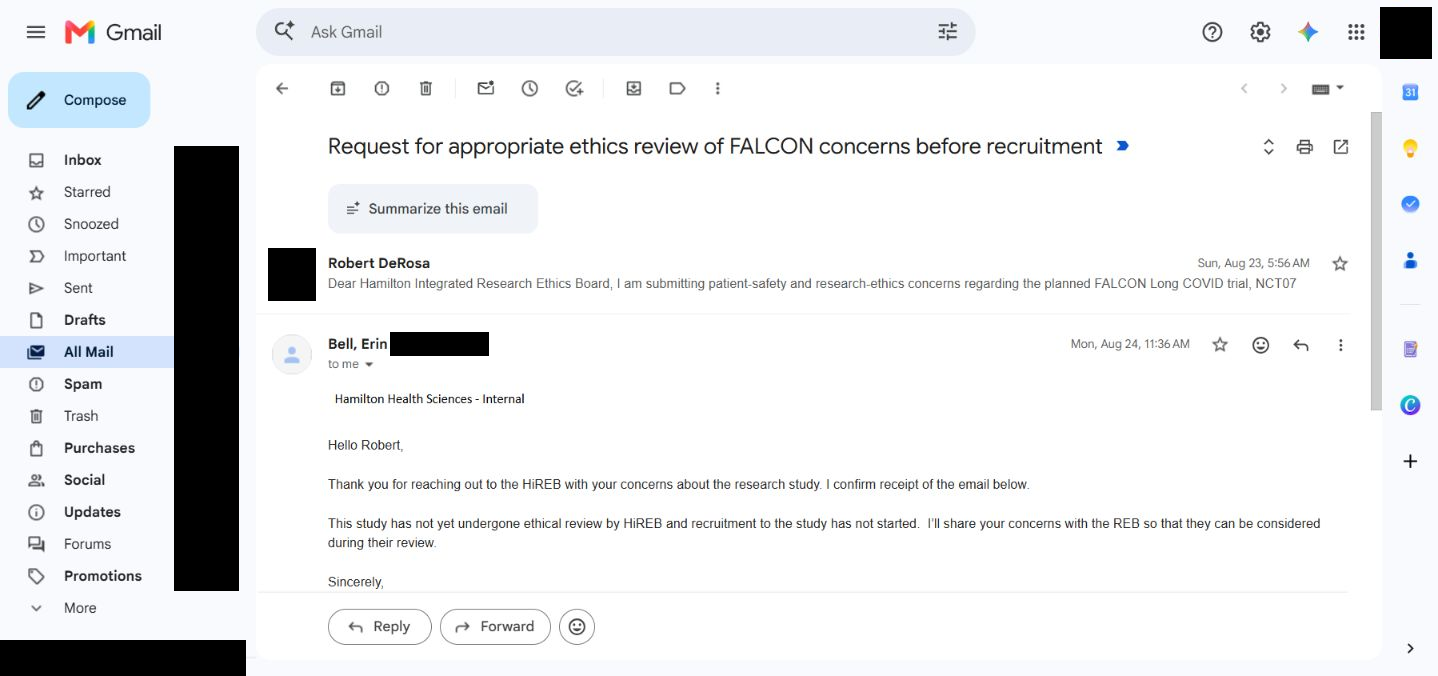
Received: On 23 August, Dr. Jason Busse told Robert DeRosa that recruitment would not begin without ethics approval. On 24 August, HiREB acknowledged LCAC’s concerns and said it would share them with the board for consideration during review. On 16 October, HiREB said those concerns were considered during initial review and the study team was addressing the board’s questions. This does not confirm the independent review requested.
Still open: Fuller disclosure of payment arrangements, licensing or materials costs, and relevant financial and non-financial conflicts before recruitment. Busse described conflict disclosure as part of publication.
Received: Busse’s 23 August reply identified $188,904 from HAHSO and said therapists would receive their usual hourly rates. His published correspondence with The Sick Times also describes contracted Lightning Process practitioners and a team member trained in its delivery.
Still open: Public access to both documents before recruitment. These responses did not supply the documents or confirm that timing.
Received: On 23 August, Busse said he was open to a detailed protocol report and would raise publication with the study team. He described publishing an analysis plan before analyses. The registry says the protocol will be public at study commencement.
Still open: A measure of physical function that does not rely only on questionnaires, and clear procedures for protecting participants. LCAC is asking how harm will be detected and addressed, rather than claiming it is absent from the registry.
Received: Busse explained the use of patient-reported outcomes and the active pacing comparison. The registry includes post-exertional malaise, adverse events and serious adverse events.
Still open: An account of what patient partners influenced and how patients will participate in the design review. LCAC acknowledges the reported involvement; its extent and decision-making role remain to be clarified.
Received: On 23 August, Busse told Robert DeRosa that patient partners were team members and had reviewed the protocol.
Share the petition, personalize an email, or help examine one research question. Choose what fits your energy; joining LCAC is not required.
Share the petition with someone who may want to support independent review. Choose the way that works for you.
Open an email to share FALCON Why this mattersPersonalize a draft asking for independent review and public trial documents before recruitment.
Read and personalize the email Why this mattersSend LCAC your email and any reply. No response yet? Your original email is useful too.
Share correspondencePrivate submission. We will ask separately before publishing any part.
Read the latest updateCompare two public descriptions of one eligibility rule and send LCAC a short, sourced note.
See the document-review task Why this mattersHave other evidence or expertise to contribute? Contribute at your own pace, with no fixed time commitment. Offer evidence or expertise →
Choose an email draft or review task, or read LCAC’s sent HAHSO letter.
Ask for a public response on the outstanding review and disclosure requests.
Recipient: vprsrch@mcmaster.ca, the institutional Office of the Vice-President, Research. Check McMaster’s official contact listing ↗
Replace or remove the brackets and send only what reflects your views.
Using webmail? Copy the subject and message below into a new email.
Subject: FALCON: independent review before recruitment
Dear Office of the Vice-President, Research,

I support the call to pause recruitment for FALCON (NCT07697261) until an independent scientific, ethical and patient-led review has addressed the concerns raised about the trial.

[Optional: Add a sentence about why trustworthy Long COVID research matters to you.]

Please publish the full protocol, statistical analysis plan and the review’s findings before recruitment begins. Please explain how McMaster will respond to the outstanding requests and when a public response can be expected.

People with Long COVID need research that produces reliable answers and protects participants.

Thank you,
[Your name]

Campaign background: https://longcovidaction.ca/falcon
Received a reply? Forward it to hello@longcovidaction.ca or share it through the form for review.
HiREB confirmed initial review and consideration of community concerns on 16 October. The email action is now closed; the campaign’s five asks remain open. Read the reply.
Already emailed? Share your correspondence.
This was the earlier outreach draft; it is retained for the campaign record.
Dear Hamilton Integrated Research Ethics Board,

I am writing about participant protections in FALCON (NCT07697261). I understand that HiREB has acknowledged Robert DeRosa’s August concerns, and I would appreciate an update on how they are being considered.

[Optional: Add a sentence about why participant protection matters to you.]

Please explain how the review will address worsening symptoms after exertion, informed consent and participants’ ability to withdraw without pressure. Please support publication of the participant information and consent materials before recruitment, and provide a public summary of the safeguards where possible.

Please let me know when a response can be expected.

Thank you,
[Your name]

Campaign background: https://longcovidaction.ca/falcon
Compare one eligibility rule in two documents. No research credentials or full trial review needed.
LCAC has noticed differing descriptions of the “readiness to change” score used to determine eligibility. Your task is to help develop a precise question about which rule applies, why it is used and whether the public registration needs updating.
A brief or partial note is welcome. No personal medical history needed.
LCAC will check notes against the sources and use relevant findings in a clarification request. Publication is not guaranteed.
Sent 11 October 2026 · Response requested by 22 October
LCAC asked HAHSO to answer the funding, oversight and disclosure questions first sent on 23 August.
Sent to the HAHSO office (hahso@mcmaster.ca), addressed to Sarah Bouma and Dr. Ahmed Khan, with a request to forward it to the responsible person. Check McMaster’s HAHSO office listing ↗
You can also read the full text below.
Sent · 11 October 2026
To: Sarah Bouma and Dr. Ahmed Khan, Hamilton Academic Health Sciences Organization (HAHSO)
Re: FALCON funding - follow-up on my 23 August 2026 inquiry (NCT07697261)
Dear Sarah Bouma and Dr. Ahmed Khan,
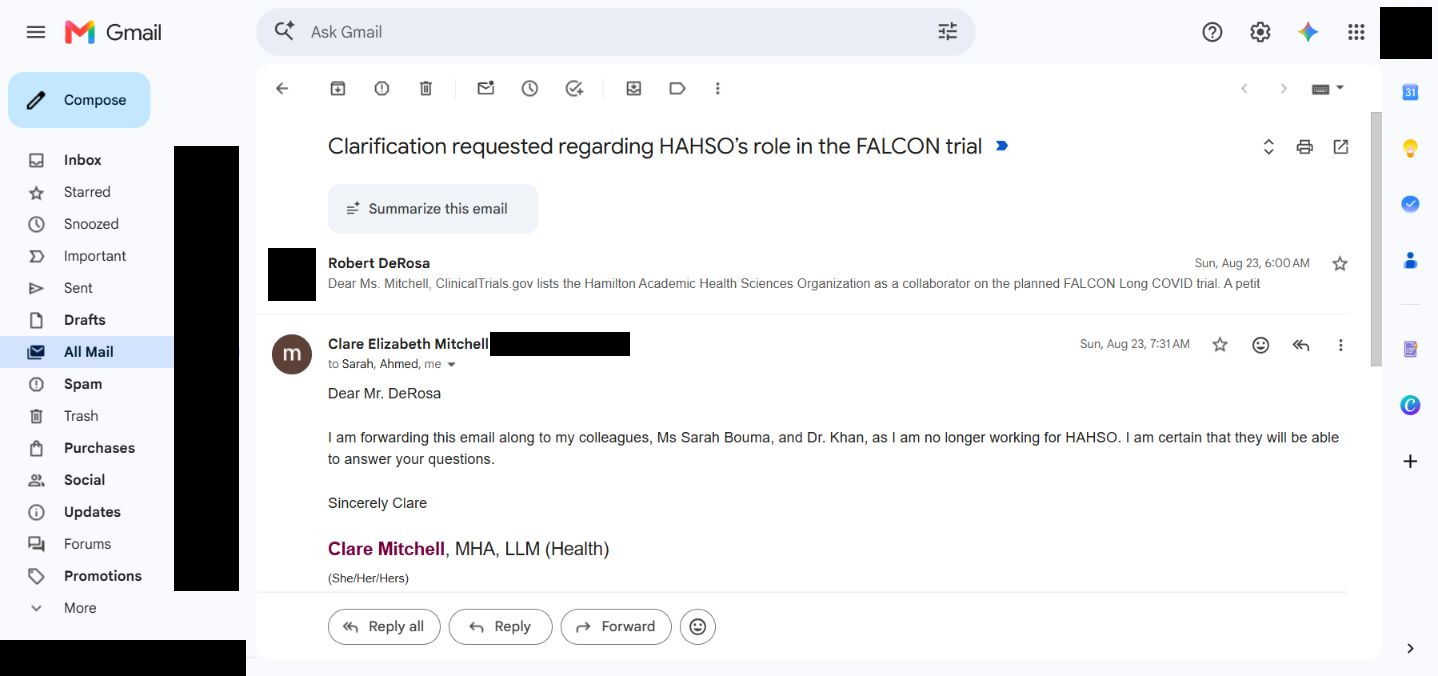
I am writing for Long COVID Action Canada to follow up on my 23 August 2026 email about funding for FALCON (NCT07697261), McMaster's trial comparing activity pacing with the Lightning Process for Long COVID. Clare Mitchell replied that day, saying she no longer worked for HAHSO and forwarding my inquiry to you. I am requesting a substantive written response.
Dr. Jason Busse's August correspondence identified HAHSO funding of $188,904. The source and reported amount are therefore already part of the record. I am seeking details of the award's conditions, assessment, oversight and transparency.
ClinicalTrials.gov, checked on 8 October 2026, lists FALCON as "Not yet recruiting," with an estimated November 2026 study start. The record was last updated on 13 July. This is the published registry information, not confirmation of current enrolment. Clarity before recruitment would help patients understand how the concerns raised are being considered.
Please address the following:
LCAC's record acknowledges investigator replies and HiREB's acknowledgment of our concerns. Those communications have clarified some matters; they do not by themselves establish that the outstanding requests have been fulfilled. Funding oversight and ethics review have distinct responsibilities, and I am seeking a clear account of HAHSO's role.
Please acknowledge receipt and confirm that this has reached the responsible office. I would appreciate a substantive written response by 22 October 2026, ahead of the estimated November start. If that timing is not feasible, please indicate when you can respond. I would welcome a response suitable for inclusion in the public campaign record. If a question belongs elsewhere, identify the responsible office while addressing the matters within HAHSO's remit. Please distinguish steps already completed from proposed actions.
People with Long COVID need research they can assess and trust. Clear answers would help.
Thank you for considering these requests.
Sincerely,
Robert DeRosa
Founder, Long COVID Action Canada
Long COVID patient advocate
We will record a reply, or the absence of one by 22 October, before deciding on the next follow-up or a public email action.
The HAHSO email action remains paused. Choose one of the current FALCON actions.
Use the McMaster draft for outstanding campaign questions. HiREB outreach has closed following its reply. Already emailed? Share your correspondence.
| Person or office | Campaign questions | Public email |
|---|---|---|
| Dr. Jason BussePrincipal investigator, FALCON | Trial design, protocol, outcomes and publication plans | bussejw@mcmaster.caPublic contact source |
| Hamilton Integrated Research Ethics Board (HiREB)Research ethics board | Ethics review, informed consent and participant protections | hireb@hhsc.caPublic contact source |
| Dr. Gianni Parise · research officeVice-President, Research, McMaster | Institutional research oversight and response to the review request | vprsrch@mcmaster.caPublic contact source |
| Dr. Nancy Baxter · dean’s officeDean and Vice-President, Health Sciences, McMaster | Faculty leadership and response to the campaign’s concerns | deanfhs@mcmaster.caPublic contact source |
| Dr. Susan Tighe · president’s officePresident and Vice-Chancellor, McMaster | University leadership and institutional accountability | president@mcmaster.caPublic contact source |
| Hamilton Academic Health Sciences Organization (HAHSO)Reported funding body · HAHSO Administration | Funding transparency, grant conditions and oversightContact listed for reference. The public HAHSO email action remains paused pending LCAC’s follow-up. | hahso@mcmaster.caPublic contact source · HAHSO Administration |
Public contact sources checked 13 October 2026. Office addresses are used for institutional leaders. A listing does not imply agreement with the campaign. The HAHSO action remains paused.
Replies and referrals to Robert DeRosa and LCAC, including HiREB’s 16 October review-status update. None confirms the independent review requested.
These exchanges describe the position on their dates. Private details are redacted; substantive wording and original classification labels are retained.
| Date | From | What they said | Read the exchange |
|---|---|---|---|
| HiREB · Mandy HindleInitial-review status update | Initial board review took place; the study team is addressing the board’s questions and concerns. Community concerns were considered. No timeline for answers to LCAC’s questions was provided. | Read the reply text | |
| HiREBInternal referral | Referred LCAC’s follow-up to a colleague for assistance, copying LCAC. | Timeline record |
| Date | From | What they said | Read the exchange |
|---|---|---|---|
| Dr. Jason BusseInvestigator response | Discussed funding, publication plans, outcomes and patient partners; stated that the trial would not begin without ethics approval. | ||
| HiREB · Erin BellAcknowledgement | Said the study had not yet undergone HiREB review and recruitment had not started; would share the concerns with the board. | ||
| Clare MitchellHAHSO referral | Said she no longer worked for HAHSO and forwarded the inquiry to Sarah Bouma and Dr. Ahmed Khan. This did not answer the funding or oversight questions. |
August text and PDF versions include the exchanges and original requests, with redacted screenshots. The 16 October entry links to a reformatted transcript of that reply body. The 13 October referral is summarized in the timeline.

People with Long COVID demand pause of McMaster University clinical trial ↗
Reporting by Simon Spichak, 22 September 2026.
Watch Miles Griffis explain the concerns in The Sick Times’ accompanying video.
September 2026 coverage reflects information available at publication. See Latest status for subsequent developments.
The Sick Times, September 2026. Original reporting and wording; the figures and trial status describe that time. The closing invitation to comment refers to the original social-media reel.
Over 1,700 people have signed a petition calling for a review of a Canadian clinical trial testing a pseudoscientific mind-body program for Long COVID.
Researchers at McMaster University are planning to test an expensive program called the Lightning Process, even though Long COVID is a biological disease.
The program has been heavily criticized by experts and called quackery. Plus, some UK health guidelines actually recommend against it for similar diseases like myalgic encephalomyelitis or ME, which some people with Long COVID have.
The program has also been accused of exploiting vulnerable people with Long COVID and has faced pushback from regulators for false advertising.
And on top of all of this, a BBC undercover investigation found the coaches of the program falsely told people with Long COVID that quote almost anyone can recover from the disease by changing their thoughts, language, and actions.
The petition calls for objective outcome measures of the plethora of biological abnormalities found in Long COVID as the proposed study currently lists subjective measures.
It also calls for an independent review of the trial's design, transparency, participant protections, and its commercial conflicts.
Our reporter, Simon Spichak, asked one of the investigators about the trial and how the program has been accused of pseudoscience by outside experts.
The researcher said that he was not an expert in the program and that it was controversial but did not address any of the claims on pseudoscience.
Simon also found that the trial will contract Lightning Process coaches, which means that the program will be profiting off of the trial.
With little funding for Long COVID in Canada, petition author Robert DeRosa says it feels like, quote, the dark ages, unquote, with researchers trialing interventions like this.
Read more at TheSickTimes.org and comment “news” to get more stories in your inbox like this.
Supporter email drafts: the McMaster email is available above. The HiREB draft is archived following its reply. The sent HAHSO funding letter is linked below.
HiREB’s 16 October initial-review status update — public reply transcript.
HiREB’s 24 August acknowledgement and the original request — redacted PDF, text version and email screenshot.
LCAC letters sent 11 October 2026
The replies and referrals above cover August–October 2026. Each entry identifies its date and source. The published journalist exchange is a separate record. Statements about the registry refer to the version checked on 8 October 2026.