Disability Tax Credit and Canada Disability Benefit
A guide for people with Long COVID
What is the Disability Tax Credit?
The Disability Tax Credit (DTC) is a non-refundable tax credit for people with severe and prolonged impairments. It can reduce income tax for you or an eligible supporting family member.
“Non-refundable” means it reduces tax you owe; any unused amount is not paid to you as cash. DTC approval can also help you access other disability programs.
How does the Canada Disability Benefit relate?
The Canada Disability Benefit (CDB) is an income-tested payment. You need DTC approval, then a separate CDB application. You may qualify even if you owe no income tax.
About this guide and eligibility
- The DTC is a tax credit. Approval also unlocks other programs, including the Canada Disability Benefit (CDB) and the Registered Disability Savings Plan (RDSP), each with its own rules.
- Eligibility depends on how Long COVID limits your daily activities, not on the diagnosis.
- You can work through this in short sessions. Nothing here needs to be done in one sitting.
This is general information, not tax or legal advice. CRA decides DTC eligibility. Service Canada decides CDB eligibility.
A Long COVID diagnosis, being unable to work, or receiving another disability benefit does not on its own make you eligible. Robert’s examples show how one person documented his limits. They are not a template or a prediction.
Rules and amounts change. Check the linked government pages before you apply.
Key numbers at a glance
- Up to about $1,448Maximum federal tax saving for an adult, 2026How this works
- Up to $204.20/monthMaximum CDB per month, July 2026–June 2027Payments
- Up to 10 yearsHow far back DTC claims can go, if approvedPast years
- 90 daysCRA objection: from the notice of determinationReview options
- 180 daysCDB reconsideration: from the decision-letter dateCDB decisions
DTC: who benefits and how much?
For 2026, an adult can save up to about $1,448 in federal tax, plus applicable provincial or territorial savings. Eligible past-year claims may go back up to 10 years.
Who can benefit, including people who owe no tax?
If you pay income tax
After CRA approval, claim the disability amount on your return to reduce tax payable. This can result in a refund of tax already paid. The disability amount is a credit calculation amount, not a cash payment of that size. CRA: What the DTC provides
If you pay little or no income tax
You may still benefit through access to programs such as the Canada Disability Benefit and Registered Disability Savings Plan, subject to their separate rules. An unused DTC amount is not paid to you as cash. CRA: Related programs
How much is the DTC worth?
For an adult in the 2026 tax year:
| What the amount means | Federal amount |
|---|---|
| Disability amount used to calculate the credit | $10,341 |
| Maximum federal income tax saving | About $1,448 |
You do not receive $10,341 as a payment. At the 2026 credit rate of 14%, $10,341 reduces federal tax by up to $1,447.74. The actual saving depends on the tax you or an eligible supporting relative would otherwise owe. Department of Finance: 2026 DTC value
Provincial or territorial disability credits may add further savings; the amount depends on where you live and the tax year. Children under 18 may also qualify for a supplement. CRA: Provincial and territorial tax packages · CRA: Child supplement
Department of Finance: how the 2026 credit rate is calculated
Can I claim for earlier years?
Yes. You may be able to claim the DTC retroactively for up to 10 years, if CRA approves eligibility for those years and you did not already claim it. Your practitioner must support when the qualifying restrictions began; the approval notice sets out the eligible years.
You can consent on the application to CRA adjusting eligible previous returns. If those returns were not adjusted, request changes through CRA's tax-return adjustment process. An eligible supporting relative may also need to adjust their own returns for past-year transfers. CRA: Claiming for past years
Example: If you apply in 2026 and CRA approves eligibility from 2020, you may request adjustments for eligible 2020–2025 returns. Each year uses that year's credit amounts and your tax situation. You are not automatically entitled to 10 years of refunds, and you should not multiply the 2026 maximum by 10 to estimate a refund.
There is a time limit: CRA generally cannot issue a refund for an adjustment requested more than 10 calendar years after the tax year ends. CRA: Changing a return
Can a supporting family member claim the unused amount?
If a family member supports you
You may transfer the portion you do not need to reduce your tax to an eligible supporting family member. You must depend on them for at least one basic necessity: food, shelter or clothing.
Eligible relatives include your spouse or common-law partner; parent, grandparent, child, grandchild, sibling, aunt, uncle, niece or nephew; and the listed relatives of your spouse or common-law partner. A friend or unrelated roommate is not on this list. CRA: Supporting family members
How to arrange a transfer
- Include the supporting person's details in Part A, question 2 of your DTC application.
- If they were not listed, they can send CRA a signed written request identifying the transfer and describing their support for basic necessities.
- Once approved, calculate the unused amount for the tax year and claim it on the appropriate return. CRA: Transfer instructions
| Who is claiming? | Federal return line |
|---|---|
| You, for yourself | 31600 |
| Your spouse or common-law partner | 32600 |
| Another eligible supporting relative | 31800 |
The supporting person must meet the rules for that claim; being related alone is insufficient. Other dependant claims can affect who may claim or split the amount. Combined claims cannot exceed the available amount. CRA: Dependant claims and exceptions · Spouse/partner claims
Example: You have Long COVID, no tax payable and rely on a parent for housing and meals. If the transfer rules are met, your parent may claim the unused amount to reduce their tax. Your DTC approval remains yours; this is a transfer of the unused tax amount.
Keep records of the support provided and check each eligible tax year. The transfer helps only to the extent the claimant has tax to reduce. It does not itself enrol you in the CDB or transfer CDB payments to a relative.
Don’t miss the RDSP
If you’re DTC-approved, check whether a Registered Disability Savings Plan (RDSP) could help you save for the future.
Grants, bonds and age limits
For people with low income, the Canada Disability Savings Bond can add up to $1,000 a year even if you contribute nothing. Unused grant and bond entitlements can be carried forward for up to 10 years, if you met the rules in those years.
Grants and bonds stop at the end of the year you turn 49. You must open a new plan by the end of the year you turn 59, unless the transfer exception applies. DTC approval alone is not enough: residency, a valid SIN and other rules also apply.
Government of Canada: RDSP · Grant, bond and carry-forward rules · Opening a plan: eligibility
RDSPs are for long-term savings. Withdrawals or closing a plan can require repayment of government money. Check with the financial institution before taking money out.
What DTC approval can unlock
Each program has its own rules. DTC approval does not enrol you in all of them.
- RDSP grants and bonds: government help with long-term savings.
- Canada Disability Benefit: an income-tested payment for eligible working-age adults.
- Canada Workers Benefit disability supplement: additional support for eligible workers with low income.
- Home Accessibility Tax Credit: a credit for eligible home accessibility expenses.
- Child Disability Benefit: support for eligible families caring for a child with a disability.
Apply for the DTC
Save my place: optional six-step checklist
You can pause here. Tick a step when you’re ready to move on. This is a personal reminder, not an eligibility assessment.
Saved only in this browser on this device. No account needed.
- 1. Check the criteria
- 2. Identify affected activities
- 3. Write a short summary
- 4. Talk to your practitioner
- 5. Complete the application
- 6. Check CRA’s decision
1. Check the criteria
Check how CRA defines a restriction in daily activities.
Suggested pace: Low effort: read one rule at a time.
Eligibility rules
You can apply even if you have little or no taxable income. CRA: What is the DTC · CRA: Who is eligible
CRA asks whether you have a “marked restriction” in an everyday activity like walking, thinking and remembering, preparing food, or dressing. That usually means:
- You can’t do it, or it takes at least three times longer than for someone your age without the impairment.
- Even with appropriate treatment, medication or devices.
- Almost all the time (about 90% or more).
- For at least 12 months continuously, or expected to last that long.
You do not have to wait 12 months if the restriction is expected to last that long. Other categories, including life-sustaining therapy, have different rules. CRA: Eligibility criteria
If several activities are each significantly limited, together they may count. See When several activities are affected.
2. Identify affected activities
Think about walking, mental functions, feeding and dressing.
Suggested pace: Low effort: choose one affected activity.
Examples and combined limitations
| DTC category | What to describe if it applies to you |
|---|---|
| Walking | Distance, time, stops, help and devices needed. Explain how fatigue, pain, breathlessness or dizziness restrict walking. |
| Mental functions | How memory, concentration or other cognitive difficulties affect simple daily tasks, understanding instructions, decisions or safety. Record reminders or supervision needed. |
| Feeding | Difficulties preparing food or feeding yourself: handling utensils, chopping, lifting or completing the task. Describe help and extra time needed. |
| Dressing | Difficulty putting on or removing clothes, bending or fastening buttons. Include rests, assistance and time. |
Use the criteria for each relevant category: walking, mental functions, feeding and the full category list.
Feeding has specific limits. Preparing food can count, but shopping for or obtaining food does not. Extra preparation time caused only by a dietary restriction or regime is excluded. Describe the impairment that prevents you preparing food or feeding yourself. CRA: Feeding exclusions, section 2.10
When several activities are affected
Ask your practitioner about the cumulative effect of significant limitations if you have limitations in two or more DTC categories that together are equivalent to one marked restriction. The limitations must exist together all or almost all of the time and meet the duration and treatment criteria.
Memory and concentration are both within mental functions; they do not count as two separate categories. Walking and mental functions are separate categories. CRA: Cumulative effect
3. Write a short summary
Note what happens, how often, how long tasks take and what help you need.
Suggested pace: Low effort: add one example per session.
Template and post-exertional malaise
For each affected activity, record:
- What happens: the task you cannot complete or struggle to complete.
- Time and help: rests, reminders, supervision, devices or physical assistance.
- Frequency: how often the restriction occurs, including better and worse days.
- Duration: when the restriction began and whether it continues.
- Treatment: what helps and what difficulty remains.
Suggested wording to adapt:
Since [date], I have difficulty with [activity]. On [frequency], I need [help/rests/device] and it takes [time], compared with [reasonable comparison]. Even with [treatment], [restriction] remains.
Use honest estimates where necessary and label them as estimates. Avoid describing only your worst day or minimizing the support that makes a task possible.
Make support visible. If someone prepares your meals, prompts you through a task or reminds you to take medication, describe what they do and how often. Note difficulty that remains despite aids or treatment. A short record of ordinary days can help; it is a preparation aid, not a separate eligibility test. Disability Alliance BC: Practitioner guide
Explain post-exertional malaise and changes over time
Post-exertional malaise (PEM), also called post-exertional symptom exacerbation (PESE), means symptoms worsen after activity. The worsening can be delayed.
Describe the trigger, when symptoms worsen, how long they last and which daily activities become restricted. Explain what pacing or rest allows you to do and what remains difficult.
Do not assume that recovery time automatically counts toward CRA's three-times-longer test. Ask your practitioner to explain how it affects the relevant activity and the overall pattern of restriction. Fluctuating symptoms still need to be assessed against CRA's frequency requirements. CRA: Eligibility
These are practical documentation suggestions. You do not need to push through symptoms to gather examples; use existing experience and records.
PEM can follow physical, cognitive or emotional effort. Include what happens after tasks as well as during them. Long COVID Physio: Post-exertional symptom exacerbation
Optional: build your summary one activity at a time
Fill in what you can. Short notes are fine. Label estimates. This tool does not send your notes to LCAC.
Use CRA’s DTC categories. Check the feeding exclusions and the PEM recovery-time note.
Your summary
Off by default. Only save on a device you trust. This tool does not encrypt saved notes. Avoid shared or public computers.
4. Talk to your practitioner
Bring your summary and relevant records. Ask them to assess the DTC criteria.
Suggested pace: Appointment: ask for help preparing.
Preparing for the appointment
Bring your summary, relevant medical records and any useful specialist letters. Ask the practitioner to connect the evidence to the DTC criteria and confirm the onset of the restrictions. A diagnosis date and a restriction's start date may differ.
A doctor or nurse practitioner can certify all impairment categories. Other eligible practitioners can certify specific categories; for example, a psychologist can certify mental functions. Ask about any form-completion fee. CRA: How to apply
Suggested appointment request:
I would like to discuss applying for the Disability Tax Credit. I have prepared a short summary of how Long COVID affects my daily activities. Could you assess the relevant DTC categories and complete Part B if supported by your assessment?
Include other conditions where relevant, but have the practitioner verify diagnoses and medical details. Do not copy diagnostic codes from someone else's application.
A Long COVID specialist is not a required certifier. Your eligible practitioner may use your reported symptoms, medical history, observations and relevant records. Bring older records if you are asking them to assess restrictions that began before you became their patient. CRA: How practitioners assess patients
For practitioners completing Part B
Your patient has prepared a summary of how Long COVID affects their daily activities. Assess each relevant category against CRA’s criteria: frequency (all or almost all of the time), duration (at least 12 continuous months, or expected to last that long), and the effect of treatment, medication and devices.
For patients with PEM, describe both the immediate limitation and delayed worsening after activity. Explain how this affects the task over a typical day. Recovery time does not automatically count towards the three-times-longer test.
If several categories are significantly limited, consider the cumulative-effect section. Use your professional judgement. Only an eligible practitioner completes Part B.
CRA: How practitioners assess patients · Disability Alliance BC: Practitioner guide
5. Complete the application
You complete Part A. Your practitioner completes Part B. Use the same method for both.
Suggested pace: Forms: split this across sessions.
Digital and paper instructions
Use the current CRA application instructions. Choose one method; Part A and Part B must use the same method.
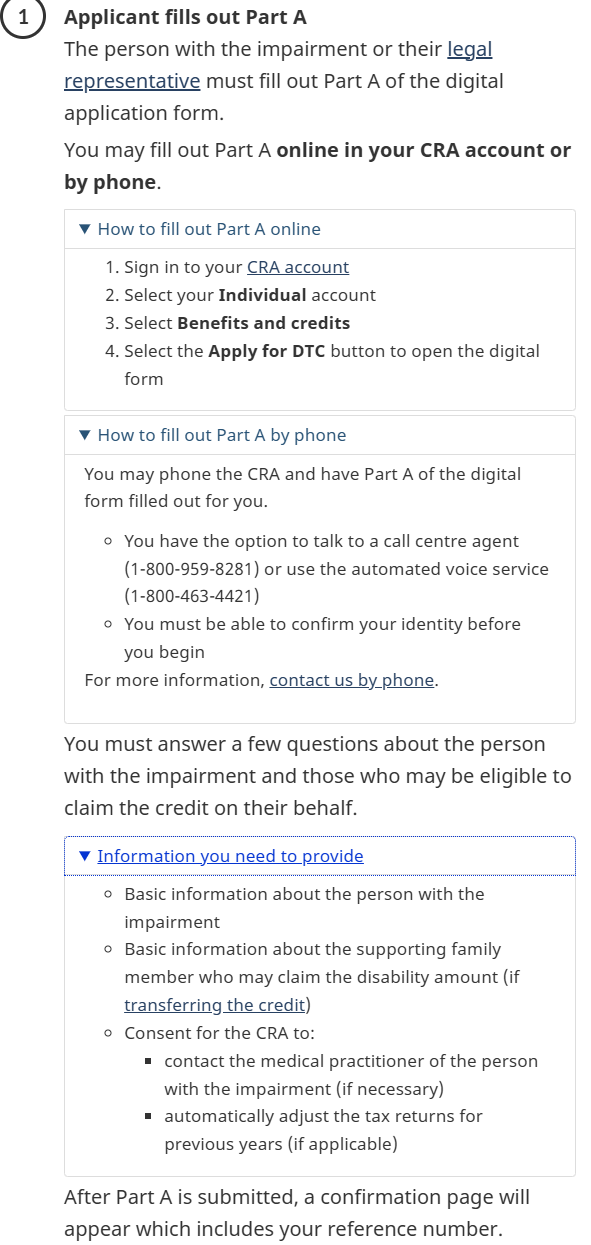
Digital: Complete Part A through your CRA account or by phone. Give the reference number to your practitioner, who completes and submits Part B digitally. Completing Part A alone does not finish the application.
View the dated instruction screenshot
Paper: Get the current Form T2201. Complete and sign Part A. Your practitioner completes and certifies Part B. Mail the complete application using CRA's current instructions.
Save a copy and submission confirmation. For additional evidence, follow CRA's instructions for your application or any request letter. Avoid sending duplicate applications.
2026 submission changes: Since July 14, 2026, do not use “Submit documents” for a new DTC application or unsolicited related documents. Use it only when CRA specifically requests information and supplies instructions. Since September 8, 2026, forms from before 2023 are no longer accepted. CRA: Updated submission rules
Helping someone apply: authorization and legal representation
A trusted person can help you read instructions and organize notes. This does not give them access to your CRA account or authority to sign for you.
To authorize someone to deal with CRA, sign in to My Account. Choose Profile → Authorized representative(s) → Add, then follow the prompts. You can also confirm a request they submit through Represent a Client. Choose the access level you need. CRA: Authorize a representative
An authorized tax representative is different from a legal representative, such as a person acting under a valid power of attorney or court appointment. CRA must receive the legal documents before recognizing that authority. Being a caregiver or family member alone does not give it.
For a paper DTC application, an adult signs their own Part A unless a legal representative has been appointed. CRA authorization alone does not make someone a legal representative or allow them to certify Part B. CRA: Legal representative · CRA: DTC signing instructions
6. Check CRA’s decision
Read the approved years or reasons for denial. Check any deadlines promptly.
Suggested pace: Time-sensitive: check any deadline first.
Approval, review and objections
Applied and waiting: what happens next?
Check your application’s progress in your CRA account after CRA receives the complete application. Watch for requests for more information. CRA: Review and application status
If approved: Check the eligible years and any expiry date. Approval and claiming the credit are separate steps. Claim it on your return and check whether previous returns were adjusted. Eligible past-year claims may go back up to 10 years. An unused amount may be transferable to an eligible supporting family member; approval does not guarantee a refund. CRA: Claiming the credit
When your approval ends
Your CRA notice may list an end year. Put a reminder in your calendar now. Plan to reapply with updated medical certification during that year to avoid a gap in DTC eligibility. If there is no end date, you do not need to reapply unless CRA asks. CRA: Renewal instructions
DTC approval is required for the CDB and new RDSP grants and bonds. An existing RDSP can stay open after DTC approval ends, but contributions and new grants or bonds stop. Losing approval alone does not require repayment of grants and bonds already in the plan. Government of Canada: If you lose DTC approval
If CRA asks for more information: Work with your practitioner to answer the specific questions and meet the deadline in the letter.
Denied or disagree: review and objection options
If denied, or if you disagree with the approved years: Read the reasons alongside your application. You may request a review and provide new medical information. CRA currently instructs you to mail a review request and documents to the tax centre that processed your application. You also have the right to file an income tax objection within 90 days of the notice of determination. Do not assume an informal review extends that deadline. CRA: Decision and review options
Check other benefits separately: DTC approval does not automatically start Canada Disability Benefit payments. See “Next: apply for the Canada Disability Benefit” below for the next steps.
Next: apply for the Canada Disability Benefit
DTC approval does not start CDB payments. Apply separately to Service Canada. The maximum is $204.20 per month for July 2026–June 2027; your amount depends on family income.
Who can qualify, and where do I start?
Where to start
- Already DTC-approved: Check the remaining CDB requirements and apply to Service Canada. The CDB application does not require another T2201.
- Not DTC-approved: Apply to CRA for the DTC first. After approval, apply separately for the CDB.
- Receiving CPP disability, ODSP or another disability benefit: You still need DTC approval. Those benefits do not replace this requirement.
DTC and other disability programs · CDB requirements
Who can qualify
Generally, you must be 18–64, have DTC approval, be a Canadian resident for income tax purposes and meet the citizenship/status requirements. You and your spouse or common-law partner, if applicable, must have filed your tax returns. For the July 2026–June 2027 payment period, this means 2025 returns.
You may apply up to six months before turning 18, but a decision and payments wait until you turn 18. People 65 or older may qualify for certain back payments for earlier eligible months. Full eligibility rules
How do I apply, with or without an invitation?
An invitation letter from Service Canada includes a six-digit application code. You can apply without a letter or code.
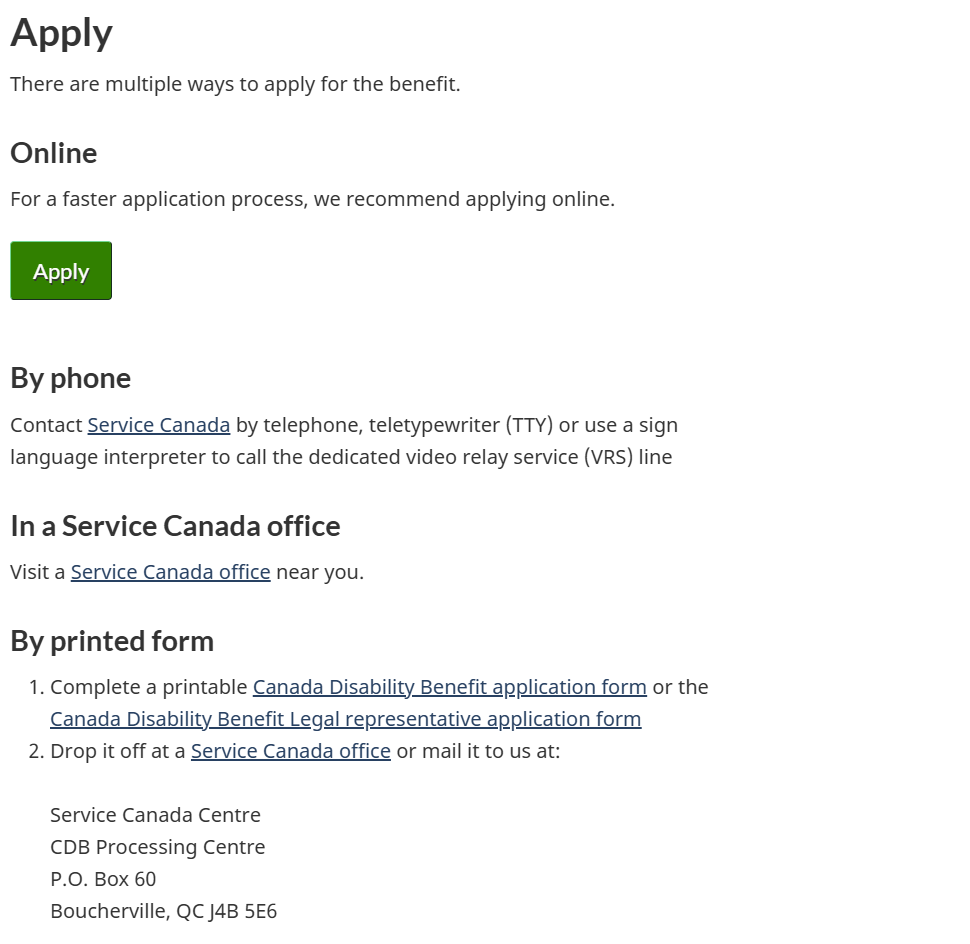
Apply online, by phone, at a Service Canada office, or using a printed form. Someone you trust can help you complete the application. A legally appointed representative can apply on your behalf with the required documents. Application options and what to have ready
View the dated instruction screenshot
Payments, income and back payments
For July 2026–June 2027, the maximum is $204.20 per month. Your amount depends on adjusted family net income, including your spouse's or common-law partner's income where applicable. You can work and still receive it; some working income is exempt.
Eligible applicants may receive back payments for up to 24 months before their application, but never for months before June 2025. Amounts and calculation rules
Qualifying CDB recipients may also receive an automatic $150 supplement to help offset DTC certification costs. DTC approval alone does not qualify you. Payments began in September 2026, with another phase planned for winter 2027. Supplement details
CDB and provincial disability assistance
How the CDB interacts with provincial disability assistance, such as ODSP in Ontario, depends on the province and program. Check your province’s official policy and ask your caseworker about reporting requirements.
- Alberta: AISH / ADAP: federal supports and reporting
- British Columbia: Income treatment and exemptions
- Manitoba: Manitoba Supports: CDB update
- New Brunswick: Policy manual: income types
- Newfoundland and Labrador: Income Support: CDB announcement
- Nova Scotia: Income assistance regulations
- Ontario: ODSP: CDB policy
- Prince Edward Island: Income exemptions (PDF; CDB-specific treatment needs confirmation)
- Quebec: Social assistance regulations (French PDF)
- Saskatchewan: Income assistance: CDB policy
For PEI, confirm the current CDB treatment with your worker; the policy document checked did not establish it. For territories, ask your income-assistance office for its current CDB policy.
Keep payments going or challenge a decision
You do not need to reapply every year. Keep filing taxes and maintain eligibility, including DTC approval. CDB payments are non-taxable. Keeping your payments
If you disagree with a CDB decision or payment amount, request reconsideration within 180 days of the decision letter. A further appeal can go to the Social Security Tribunal. This is separate from challenging a CRA decision about the DTC. CDB reconsideration and appeal
Deadline helper: check a decision date
Use the date on your CRA notice of determination for the DTC, or the date on your Service Canada decision letter for the CDB. These are separate processes.
The deadlines in your official letter take priority. This reminder date adds calendar days only. It does not adjust for weekends, holidays, extensions or case-specific rules. Confirm the deadline with CRA or Service Canada and act early.
DTC: 90-day CRA objection instructions. An informal review does not extend that deadline.
Examples and help
Real examples from Robert’s application materials
Robert’s older forms illustrate his experience; use the current form for your own application.
Robert's records include a preparation summary, two signed medical-form copies and an additional-evidence letter. These examples are paraphrased from the forms, with personal identifiers omitted. They describe his circumstances at the time, not a template to copy.
What the completed forms described
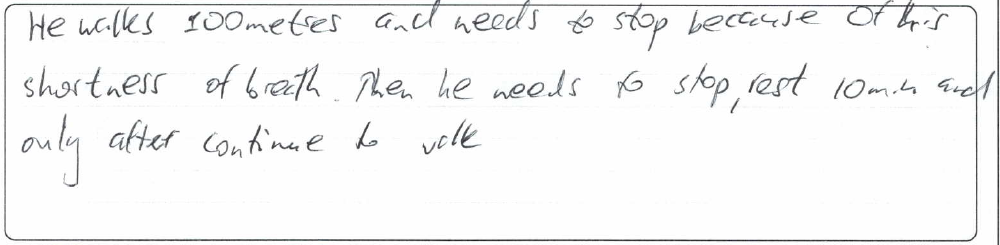
- Walking: One form described walking about 100 metres before stopping because of breathlessness, then resting for 10 minutes before continuing. Another recorded fatigue, weakness, pain, dizziness and post-exertional malaise affecting walking. (2023-version form, printed page 7; DTC Medical, printed page 7.)
- Feeding: The medical form described physical symptoms and impaired executive functioning limiting food preparation. It stated that all meals needed to be prepared by family or purchased ready-made. (DTC Medical, printed page 9.)
- Dressing: The medical form described breaks and rest between steps, with family help sequencing the task and making decisions. (DTC Medical, printed page 10.)
- Mental functions: The medical form recorded reminders to take medication and family help organizing tasks, using a calendar, tracking appointments and keeping track of personal items. It also recorded very limited capacity to focus on a simple task, make daily plans and begin everyday tasks. (DTC Medical, printed pages 11–12.)
The medical form also completed the cumulative-effect section for walking, feeding, dressing and mental functions, with restrictions recorded as beginning in 2020. This shows how several affected categories can be documented; it does not establish which category CRA relied on.
What supporting documents he prepared
- A short letter asking the practitioner to assess his daily limitations.
- A functional summary organized by DTC category, prepared with an Access RDSP/Disability Alliance BC tool.
- An August 2024 letter explaining why he was providing additional evidence and listing Post COVID clinic records and a specialist letter as enclosures.
His September 2024 CRA notice confirmed eligibility for 2020–2029. It does not identify the decisive document or qualifying category. His forms also listed conditions alongside Long COVID, so the outcome does not establish Long COVID alone as the basis of approval.
Lessons for your own application
Describe the activity, the help or rest required, its frequency and when the restriction began. Give useful measurements where available. For example, the recorded distance and rest period explain walking difficulty more clearly than the preparation summary's “slightly longer.” Do not invent a time comparison to meet a threshold.
If sending additional evidence, use a short cover letter identifying the application, explaining what information is new and listing the enclosures. Follow current CRA instructions; the submission routes shown in Robert's 2024 records have changed.
These are summaries of saved records. The signed copies alone do not prove what CRA received. Original forms, signatures and personal details are not published here.
Tools and further help
Disability Alliance BC's My DTC tool helps organize information into a letter for your practitioner. Disability Alliance BC also offers DTC support; check current service availability and eligibility.
- Personal help across Canada: Inclusion Canada's Barrier-Free Benefits offers free navigator appointments, including help with DTC applications and medical certificates.
- Long COVID-specific resources: Canadian COVID Society's disability benefits page includes its March 2026 webinar and links to application support.
- ME/CFS and fibromyalgia examples: ME|FM Society of BC's resources include a DTC recording made with Disability Alliance BC. The examples can help you describe overlapping limitations.
Start with one example. Write down an everyday activity affected by Long COVID. You can add more later.
Guide updates
- 16 October 2026 — tools updated: added an optional activity-summary builder, decision-type reminders and calendar alerts, progress counts and optional key numbers. Improved headings, printing and save/delete messages.
- 16 October 2026 — updated: added start routes, RDSP and related programs, renewal guidance, practitioner and caregiver sections, and optional planning tools. Rechecked recent federal amounts and submission changes.